Showing posts with label interlacing. Show all posts

Tuesday, February 5, 2013

Tikkun Olam by Kintsugi; but First, the Furnace and Flux

Sunday was the first anniversary of my brother's death, and as I began to write this post, something he once said popped into my head.  Commenting on my penchant for symbolism, he said something to the effect that I'm always trying to read meaning into things where there is none.

True enough; most of the content of this blog is a neon flashing case in point.  But my response to him then, as it would be now, was that basically, it doesn't matter if the meaning is "really there" or not; what matters, and what I enjoy, is creating that meaning, working - and playing - with it.  Symbology is fun.

Working and playing with gold as my color for the year has so far - pardon the pun - been quite rich.  Around the time that I realized 2013 was going to be gold, a Facebook friend posted about the Japanese art of kintsugi, which I had never heard of before.  It means "golden joinery" and is the practice of repairing broken pottery with a lacquer resin sprinkled with powdered gold, thereby making the item more beautiful and valuable than it was originally.  

How glorious!  My metaphorically-oriented mind was off and running, and the first thing I thought of was the Hebrew phrase tikkun olam, meaning repair of the world.  In Jewish spirituality, this is seen as humanity's responsibility.  

Tikkun olam by way of kintsugi; I love this concept.  But what would such a process entail?  Obviously, one needs to first have some gold.  It has to be extracted, refined, then ground to a powder and mixed with lacquer.  

As I delved more deeply into exploring the metaphorical meanings of these processes, it became clear to me that the reason gold is so valued is because it represents pure love, pure being.  If one wants to repair the world with it, one has to find it in oneself first.  And in order to do that, one has to first trust that it is actually there to be found, then actively look for it.

I realized at that point that I tend to deny the gold in myself because I recognize that it's not pure and so I discount it altogether.  But in exploring these metaphors, I began to understand that I must value the impure gold for it to be purified.  I must "extract" it by gathering it within myself from all the "veins" where I can find little bits of it. Interestingly, I discovered that just by turning my imaginative focus more to the image of gold, feelings of joy and love were increasing me.  (And by the way, I learned in my research that the human body does actually contain tiny amounts of gold.)  

The next step is purification.  Find and extract the the impure gold, then surrender it to a 2100-degree Fahrenheit furnace and add something called flux, which causes the impurities to separate and rise to the surface where they can be poured off. The funny thing about flux is that it consists of very ordinary substances, and can actually be as simple as 100% borax.  Boring old borax, available at any corner store. 

Perhaps, then, I should value the ordinary circumstances of my daily life as the flux that catalyzes my purification.  Maybe I should also welcome the intensely challenging and painful things in life when they come because they are the fiery furnace, without which, the flux has no purpose and the gold remains impure.  And perhaps, when impurities rise to the surface, I can let them be poured off instead of clinging to them because I identify with them.  Then, with the pure gold that is left, I can repair what is broken - but only after it's ground to a powder, another wonderful metaphor for appreciating life's way of taking something that seems so solid and breaking it apart so it can become useful to the world.

I feel like all of this is happening simultaneously in me, but I can give my attention to one part of the process or another, depending on my need in the moment.  I am one piece of the broken world and the whole process is the repair.  Kintsugi, tikkun olam, the furnace, and the flux are one. 

Tamamizu Ichigen , (Japanese, 1662?-1722)
Edo period

Saturday, December 29, 2012

A Purple Passage

One of the things I discovered in my research about the color purple is that a paragraph containing "ornate and flowery language" is called a "purple passage."  Metaphorically speaking, that's a good way to describe how 2012 has been for me.  Also, this year has been a major rite of passage, resulting in discovery of what a new friend of mine calls the "heart treasure," that one still point of purpose that, once discovered, turns everything else in one's life to serve it.

During the time of planning my brother's memorial, I happened to see an ad in a magazine for the Celebrant Foundation & Institute, which trains people to become professional Life-Cycle Celebrants - people who create and perform ceremonies with and for people.  I immediately knew this was for me, and I entered that funny process of coming to decide something that you've actually already decided.

At the time, I had just started working toward building my new business as a personal historian, and I questioned the wisdom of aborting that in midstream and starting another new thing.  But the rightness was so apparent to me that I took the leap of faith and signed up for the training (which I'm now in the middle of). 

The thing is, I knew I had found my true calling, and so many things that had happened in recent months all worked together to form one big twinkling, neon arrow pointing to celebrancy.  It started with writing about wedding officiants and realizing the importance of celebrations of milestones.  But the biggest thing was leading my brother's memorial.  It felt totally right to me, and many people who attended, most of whom I didn't know, gave me very positive feedback; a couple of them even leaned in and whispered, "I want you to do my funeral."  I know it may sound strange, but I am so intensely grateful to my brother for this gift.

I have always felt drawn toward ritual and ceremony.  I've even considered going to seminary; and now, in the Celebrant Institute, I've found my tribe, my place.  I'm amazed at how this vocation will draw on all my passions and talents.  I'm so used to having multiple jobs, but for the first time in my life I see the various side paths all merging into one.  And since focus on the client's personal story as a "hero's journey" is one of the hallmarks that makes a Life-Cycle Celebrant different from other kinds of officiants, the personal history business is also simply being absorbed into this profession. 

All the bells in my heart are ringing in one accord.  Hallelujah.

Wednesday, February 9, 2011

Mother and Child

*I've been told this didn't post right the first time, so I'm trying it again.  If you've already read it, sorry for the repeat.*


I'm not just the innocent that needs protecting, I'm the compassionate mother who weaves and wraps the blanket. I'm the child who is healing and the resurrected woman both.

That's one of the conclusions I came to in my Recovery post last Sunday. (Achtung: If you haven't read that post, this one is not going to make much sense.) This insight, while connected to the bat orphans, the Raccoon card, and the Inanna story I spoke of in that post, comes most deeply and directly out of these images from my 2011 collage:


This one is at the very top center of the collage.

  
This one is at the very bottom center.

When I chose the top image, it was because she was green and pretty; I felt drawn to her for no articulated reason.  I chose the little girl at the bottom because she exuded innocence to me, she represented the return to childhood that I have been experiencing in various ways and want to continue nurturing.  And she was pretty.  I put her on the green apple because I'd already chosen the apple image (because it was green, and represented abundance) and needed somewhere to put it; they just fit well together.

It wasn't until a few days later that I thought to do some research on the top image.  The little book I got her out of, A Gift of Happiness, had the picture labeled as Green Tara, but I didn't know anything about her at all.  So I Googled her and found out some wonderful things, which I printed out in green ink, put in a green folder, and read through, underlining things that particularly interested me.  What really caught my attention at that time was that she is known as "the Mother of Liberation," "the Mother of Mercy and Compassion," and she represents enlightened action.  And it struck me how perfect it was that the mother is at the top of the collage and the child at the bottom, and that both images represent aspects of myself.

After the protection and fierceness themes came up, I went back and read my folder about Green Tara again, and lo and behold, this is what I read; it didn't really register the first time:
During our spiritual growth we need to turn to our Holy Mother, Tara, for refuge.  She protects us from all internal and external dangers (http://kadampa.org/en/buddhism/tara-puja/)
Tara is a female Buddha, and Green is only one of her 21 manifestations, but is also the most popular.   According to my source, "she is the fiercer form of Tara."  In other words, she is fierce compassion, fierce blessing, fierce protection.

Wow.

Buddhism is not a religion of deity worship.  It's more like a system of spiritual practices, although I'm no expert.  But the existence of Tara goes back way far in both Hinduism and Buddhism, and it seems that she is primarily related to as a meditation deity.  There is a mantra associated with her:  om tare tuttare ture svaha, the reciting of which is said to "untangle knots of psychic energy," among other things.

According to Wikipedia, the Tara practice consists of meditating on the visual image of her in order to incorporate her qualities; in this sense she becomes an "indwelling deity," which is the same idea behind all good Christianity.  But Buddhism takes it a step further, because by practicing this as a disciplined meditation, the practitioner eventually comes to see that Tara has "as much reality as any other phenomena apprehended through the mind."  The result is "the realization of Ultimate Truth as a vast display of Emptiness and Luminosity" because "one dissolves the created deity form and at the same time also realizes how much of what we call the "self" is a creation of the mind, and has no long term substantial inherent existence."

All of this makes wonderful paradoxical mysterious sense to me, because as soon as I knew she was the compassionate protective Mother, I began imagining a story about her and the Child of my collage.  The Child knows she is protected: she doesn't have to look up to make sure the Mother's still there.  She is protected by her innocence and trust.  She knows she is safe and loved, and so she is going about her business, making her daisy chain, her creative offering.  She is aware of all that is around her and yet completely focused on her task.  The Child IS the "enlightened action" Green Tara gives birth and form to.

The Child's face is hidden, yet her essence is not.  We see the Mother's face instead, the Child's source.  We see what the Child is doing, which is playful, beautiful, and innocent, and is made possible by the Mother's protection.

In my Recovery post, I used the metaphor of a blanket for maintaining warmth, but the Mother and Child in my collage are warm without a blanket; the Mother is in fact partially naked.  This points to the time when the blanket will no longer be necessary, when the Sun itself will be my warmth.  But now it is winter, and I will continue to wrap myself close for the time being.

Which brings me to Brigid, whose holiday, Imbolc, is February 1 and/or 2, depending on your source.  She is connected with fire and water, poetry, and healing.  She is another fierce Mother, and is a goddess (or saint if you'd rather) who I've felt connected to for a long time.

One of the traditions associated with celebrating Imbolc is to make a pledge for the coming year.  Because her day affirms the promise of spring to come, the planting of seeds is a symbolic sealing of the pledge.  But because this day also marks mid-winter, the blessing and lighting of candles is part of it too.  To me, this recognizes that there is a season and movement to everything - a time to bundle up and withdraw and a time to dance naked in the sun, so to speak.

When I lit my room with many candles on Imbolc night and meditated on what my pledge would be, I sat before my collage until it became clear.  In choosing "bless" as my word for the year, I had only thought in terms of giving blessing - blessing as enlightened action, I suppose - but in gazing at the Mother and Child, I suddenly understood that it must also be about opening to receive, gratefully, the blessings of my life.  And so the pledge I made is to both give and receive Life's blessings.  

The Mother blesses the Child and the Child blesses the Mother; they dissolve into one another, into pure Being.    


Sunday, January 30, 2011

Recovery

I have a deck of Medicine Cards; each card features a different animal, and the book by David Carson and Jamie Sams gives you an interpretation of the significance of each animal.  I don't consult them much these days, but my 3-year-old, Eliana, likes to lay them all out, naming each animal.  Often she'll do this when I'm sitting in my room reading or writing in my journal, and she's pretty good about putting them back in their box when she's done.  But recently I found one that had somehow made it out into the living room and was face down on the floor.  I picked it up and it was the Raccoon card, then I went to the book and read about it.  The gist was the need to consider the meaning and uses of protection.  Kinda random, I thought, but okay - I'll take it.

I started asking myself questions like, What is worth protecting, and from what?  What do I truly have the power to protect? 

I looked up the word "protect" in the dictionary, and was particularly caught by two concepts:  guarding and covering. I thought of the verse from the biblical book of Proverbs:  "Above all else, guard your heart, for it is the wellspring of life."

Since I was still musing over the "heart surgery" metaphor from my last post, this protection theme began to take on deeper significance, especially in connection with healing.  When I looked up the word "heal," there was an emphasis on "closing," as in closing a wound.  It occurred to me that one cannot heal until after the surgery is finished, because by its very nature, surgery is an opening, not a closing.  To heal is to re-cover.

Then a Facebook friend of mine posted a link to this article and video about baby bats that have been orphaned in Australia due to flooding and were found on the ground covered in maggots.  This post would get way too long if I went off on a tangent about the significance of bats for me, but I will just point out that they are pollinators, and I do hold a strong connection with them, which I may post about some time.  Maybe it is because of this connection that I was so profoundly moved by these images:


Or maybe it's just because they're so darn cute.  Regardless, this got me thinking that one protects what is weak that it may strengthen, what is young that it may grow mature, what is wounded that it may heal.

Then, a couple of days later at Abbey of the Arts, Christine posted the theme for her 49th Poetry Party and it was "Fierceness and Courage."  She asked, "What are the things of your life you are called to protect fiercely?"  I love the word fierce, and one of the best compliments I ever got was from someone who called me fierce.  (The same person also told me I "look good disheveled" - another of my favorite compliments.)

With some of the issues I've been working through regarding a severed relationship in my life, I began to see how all of these things apply in a practical way.

I thought about St. Paul's definition of the armor of God.  I realized that the only way to truly guard my heart is to bless from it.  I saw that the thing worth protecting in me now is innocence, and the only way to protect it is to bless.  This came out of a sudden understanding that my only choice in a situation that causes me great anger and pain is either to curse or to bless.  And because the temptation to curse is so strong, so fierce, I realized I have to turn that into fierce blessing.

Did you ever see the scene in Tomb Raider when the villain has thrown a dagger toward someone, and, while time is stopped and the dagger is freeze-framed in midair, Lara Croft has to turn it around and point it back toward the villain?  It takes an immense act of will, concentration, and strength; she has to use both hands, which she cuts in the process.  That's what it's like turning cursing into blessing.

The sense of being unhinged that I spoke of in my last post, the image of a cut-up chicken, the metaphor of surgery - in contemplating protection and healing, I began to see what the next step was for me.  Interestingly, around the same time as all the rest of this, I read in Sue Monk Kidd's The Dance of the Dissident Daughter:
In an old Sumerian myth, the Goddess Inanna, making a descent to the underworld, moves through seven gates.  At each gate she must strip a piece of her clothing away until at last she is naked, arriving without any of her former trappings.  At the depth of her descent she is turned into a piece of meat and hung on a meat hook for several days before being resurrected as a woman.
All of a sudden I can see my journey over the past year or so as an integrated thing.  Starting in October of 2009, I began posting around the theme of nakedness as a metaphor for what I was experiencing in my life.  (If you click here, it will take you to those posts.)   Now I've had the meat hook experience.  Which is exactly why protection has come up, I now understand.  I'm like those baby bats - I'm fresh and new (green!) and I've been through the wringer, and now I need a warm soft blanket around me.

The mistake I've made in the past is unconsciously believing my coldness and anger can protect me, but in thinking about what a blanket does, I'm coming to understand it a new way.  A blanket protects you by keeping the warmth you already have within you from escaping.

Epiphany:  Keeping one's warmth close to oneself is not the same thing as being cold toward others.

I'm not just the innocent that needs protecting, I'm the compassionate mother who weaves and wraps the blanket.  I'm the child who is healing and the resurrected woman both.

Taking all these signs and insights that are coming to me from multiple directions is how the blanket is woven.  Or maybe a quilt would be a better metaphor.  A quilt is, after all, a kind of collage.

And speaking of collages, I haven't yet told you how all of this connects with my 2011 collage.  I'll save that for next time.

Wednesday, January 12, 2011

The Synergy of Spheres


I could start anywhere, because the collage of images I am contemplating has no beginning.  Or it has many beginnings.

But because I must start somewhere, I'll do it with the point in time just before the collage was made, which was the day before New Year's Eve 2010.  I already knew my word for 2011 was bless, and the color was green, and so I decided to make a collage that reflected these guides.  Last year was my first to use a guiding word and color, and it was a wonderful experience to go through the year with those polestars.  This year, I have taken it a step further, by creating a guiding image, or rather, a combination of guiding images, which I know I will be contemplating the connections among all year long.  And this thrills and composes me in a way I cannot describe.

As I said in my last post, I make collages usually with some kind of general intention or theme, but the specific images often continue to surprise me with meanings I did not see when I chose them, meanings that deepen and radiate with time.  I finished my collage the morning of New Year's Eve, and in the few short days into this fresh green year, I have already been amazed at what it has revealed to me. So amazed, in fact, that I had to make a mind map to start tracking the connections.

 
I would so love to see this in an interactive 3D version.  Oh wait - that's the world.

I did something like this last year too, and then attempted to discuss all the connections in one post.  Okay, it was two, plus an addendum and a poem.  I won't bombard you in this post with excited ramblings about how all the things in my mind map connect.  In fact, I won't even begin to discuss them.  However, be forewarned that I will likely be posting throughout the year about these and other connections I have yet to even see.  I just have a feeling it's going to be that way.

It truly is all connected, folks.  And I find no greater joy than in seeing and sharing that, one blooming thing at a time.

Friday, December 31, 2010

Transfiguring the World with Scissors and Glue

Making collages is something I have greatly enjoyed doing for years.  I love the whole process, the  intuitiveness and magic of it.  I love making meaning out of randomness, taking images that seem to have nothing to do with each other and interlacing them.

I don't consider myself an Artist, and it's unlikely that my collages would ever be gallery quality, but their value to me is greater than any fine work of art.  I love it when other people appreciate them, but unlike my writing, they are made mainly for my own viewing.  I do enjoy sharing them though, and especially turning people on to the joys of collage-making.  If you've never done it, give it a try! 

I start by picking a theme and motifs; it has to be something fairly loose so that I'll be open to what unexpected images reveal themselves.  The collage I started yesterday afternoon and finished this morning is my 2011 collage, with the primary themes/motifs of the color green and its associations, the heart, earth and air.

I also choose a background "canvas" right away too, as it will obviously determine how many images I can use, but it defines the collage in other ways too.  I've done several collages on mirrors, for instance.  I did one on a piece of a brown paper grocery bag, which I then burned around the edges.  I think I want to get into shadow boxes next, try some 3D stuff.  The only 3D collage I've ever done was actually more like a mosaic and was on a pencil box.  I used keys and large glass beads, and pennies.

Next I heft a stack of magazines, and sometimes old books and calendars, to my bedroom, most of which I choose randomly, but with my themes in mind I might deliberately pick some types that will be more likely to contain related images.  I then try to stick to only the stack I've chosen, although at the end of the process, if there's a gap in the collage that needs filling by something of a particular color or size, I might go look at a few others.  I didn't have to do that this time, though.

The stack I ended up with consisted of many copies of Oprah's magazine, a couple of Vogues, a jewelry-maker's catalogue, a little book about Zen called The Art of Happiness, a couple of New Mexico magazines, a couple of issues each of National Geographic, Spirituality & Health, and Garden Design, a tiny book called Roman Wisdom, and one copy of Martha Stewart's Living.

I love the indulgence of closing myself in my room and flipping through magazines with scissors in hand.  A friend once gave me an X-Acto knife for collage use as a gift; I gave it a try but found that I much more enjoy using scissors, and I'm pretty darn good with them.

So I cut out a bunch of stuff I think might work, and once I've gone through all the magazines I start laying out pieces on the background.  It's really like putting a puzzle together, and I'm always amazed how certain things fit together as though they were made for each other.  Other pieces are trickier, and sometimes I have to just put one aside and realize it's not going to work.  But if there's a piece I really want in there, I'll find a way to fit it.

This is what my bedroom looks like when I'm in the middle of a collage:


Once it's all arranged the way I want, I usually leave it overnight.  I think of this as a steeping or gelling process.  The pieces need time to get to know each other and see if they're going to ultimately be compatible. And I need to be able to come back to it with fresh eyes.

Then the gluing begins.  This is the trickiest part, because the puzzle can become extremely intricate, where several pieces have to be joined very precisely or they won't blend in a way that looks organic.  And so a big part of this step is figuring out what order everything needs to be glued in.  I have tried different glues, but always use good old glue sticks these days, because they cause the least possible amount of air bubbles and wrinkles.  They're also easier and less messy.

Once it's done, I'll prop it up somewhere and gaze at it for a ridiculously long time.  Then I'll go have a cup of coffee or something, and come back and gaze some more.  I begin to see patterns I hadn't intended.  I tell myself a story about it, interpret it.  In the past few years I have more consciously created collages as a sort of prophecy, a picture of my intentions.  It's rather like spellcasting, really; or prayer.  And then the finished collage becomes an ongoing meditation as well as a way of tracking my progress.  There is a poetry and fluidity and mystery to a collage that opens me into deep self-discovery.  The meaning sometimes seems to make itself.  To make me.

The collage below I made shortly after my 13-year-old son was born.  It hangs in my living room and I still muse upon it:  where I was then, where I am now, what has been fulfilled, what is timeless and essential in it and becomes more obviously so over time.

 
One of my favorite collages because it was so fun and felt so deliciously subversive to do was on a print of Van Gogh's Starry Night.  I call it The Starry Kosmos.


  And here's the one I finished today.  Out of all my collages, I think this one inspires the most joy in me to look at.

Sunday, July 25, 2010

At the Crossroads

I've been thinking a lot about the concept of pilgrimage lately.  It has been one of those themes that starts coming to me from several different directions at once until I find myself viewing it from a number of interesting angles. 

During the writers' conference that I participated in a couple of weeks ago, I had a major epiphany about my relationship with the San Francisco de Asis church.  From my very first post about it, I used the word "pilgrimage" to describe what I was doing in walking over there.  I said it was like taking a little daily pilgrimage, but what I've now realized is it's not a series of small pilgrimages, but only one, a long and profound one.  It's not a long journey in terms of physical distance but of time and moving through layers to an essential core.  

And today on Claire's blog, her post is titled "Pilgrimage as Inner Journey," and astoundingly connects with my own experience and thoughts.  She starts the post with a pilgrim's prayer, and one of the phrases that really jumped out at me was the plea for "a guide at the crossroads."  Because a crossroads is exactly where I am.

Ever since the writers' conference I have been dealing with the sense of moving to a deeper level with my relationship to the St. Francis church and the book I'm writing about it.  The piece I submitted for the conference workshop was woven together from various blog posts about the church, and the thematic thread I used was that of nakedness.  Some of you may remember my post last fall called "Naked in the Town Square."  I drew out the theme from that post to encompass the whole piece, and found it developing in my heart and mind as I did so.  Today in Claire's post, she talks about inner pilgrimage as a process in which she hands over to God all her life, both inner and outer, a process which feels like "stripping bare."

I am naked at the crossroads right now, because the conference made me realize that this book I'm writing is no longer hypothetical - I'm really doing it, and that process means getting more deeply involved with the church.  It occurred to me that it's time to talk to the priests and let them know what I'm doing, that it's only respectful to do so.  And also that one of my desires is to weave journalistic writing in with my memoir-ish stuff, and in order to do that I must connect with actual members of the church, get to know them, interview them.  It's time to move beyond the courtyard and enter the building, the body.  And this frightens me, for a number of reasons:  Fear of approaching people I don't know, doubt of myself having the "right" to be writing this book, boldness to claim that I'm doing so, putting myself and my writing out there to be scrutinized by people who have been members of the church all their lives.  Naked, naked, naked, in the stark light of day.  It would be so much easier to keep sitting in the courtyard with the hummingbird moths.

But honestly, the thing that frightens me most is in how I will be altered by deepening my relationship with this church.  I fear that I will be swept away, lose myself to it.  I have been flirting with the church, and now I'm confronted with the choice to make a commitment that I have no idea where it will lead.

Claire speaks of pilgrimage as a time of testing and says, "There is always a moment when it gets too much."  And to continue beyond this point requires surrender.  This is the crossroads where I now find myself.  Will I, as Claire puts it, allow the path I'm walking to "walk me?"  Even as I write this though, I realize it already is, even though I still have strong resistance.

Just now the church bells began ringing, calling the people to worship.  Today is the feast day of Santiago, and the annual Taos fiestas honoring this saint are in full swing downtown.  Hearing the bells, I feel an aching longing to be at the mass, but fear holds me back.  I'm not Catholic and I don't know how to do things like enter the pew and even if I did I would feel like a fake going through those movements.  I don't know the words spoken and sung during mass that Catholics know by heart, many of which are in Spanish, which I don't speak.  I don't know if they have childcare for Eliana or if I'm supposed to keep her with me, and I'm too afraid to ask.  And so I don't go.  I sit here and write about it instead.

Interestingly, the specific pilgrimage Claire refers to is the Camino de Santiago in Spain, and she writes of currently being elsewhere in the world, missing that place, knowing that today there is a huge celebration of the saint for which it's named. 

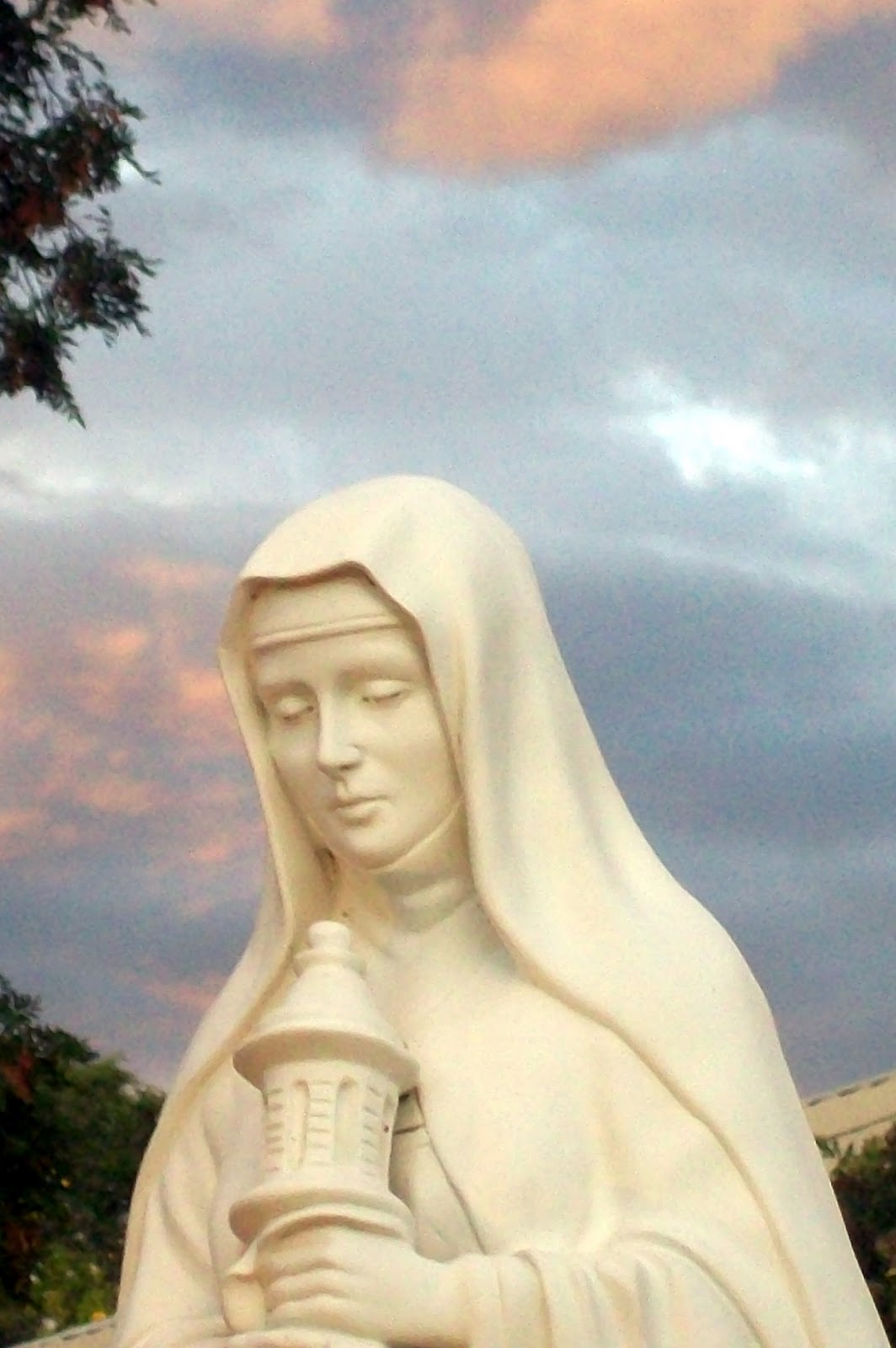
An amazing thing that came to me through the conference was in a discussion I had with one of the other participants who said she sensed that my deepest connecting point with the church is through St. Clare, not only in terms of the statue in the courtyard that I love, but also her story, that this woman perceived wants to be told and lived through me.  So today I am thankful to both my Cla(i)res for being my guides at the crossroads, and the awesomeness of this interlacing is not lost on me.

The name, Cla(i)re, of course, is related to clarity and light.  I have many photos of the statue of Clare in which she is framed by incredible clouds.  This is the metaphor I turn to today.  Recently I closely inspected an iron cross in the courtyard that I had never paid much attention to before.  I discovered that there is a Latin inscription on it, "Occurrent nubes," which Googling led me to learn means, "Clouds will intervene."  I love the mystery of this, I love that I can look at the clouds of my own doubt and fear and see how they interfere with my clear direction, but also in some way contribute to the overall pilgrimage.  A pilgrimage is not a straight walk from here to there.  Clouds refract light into variegated beauty.  They soften the harsh light that exposes nakedness.  They intervene on behalf of clarity if I only pay attention and keep walking the path, however haltingly. 

Wednesday, June 2, 2010

Easy Runner

I went for what has become my usual morning run a little late this morning, and when I came out of the grove into the church lot, there were quite a lot of cars and people, and it looked like a funeral.  Turns out it was Dennis Hopper's, which I began to suspect by the eclectic nature of the crowd.

I tried to stay to the perimeter of the parking lot to be respectful, but as I ran past a parked car with an open door, I couldn't help but notice that a man was sitting there in his underwear putting on dress pants.  Anyhoo.

I definitely felt a pang when I heard that Hopper had died, since True Romance, one of my very favorite movies, features him.  In fact, there is a truly brilliant scene between him and Christopher Walken which I feel is one of the best scenes in any movie, ever.  I'm glad for the grace that allowed me to brush up against his funeral and, however briefly and incompletely, honor his life with the expression of my own through running, something I'm completely stoked to finally be doing.  I've realized that I'm a person of passion and intensity and if I don't give that energy a release in vigorous physical activity, it's going to assert itself in less healthy ways. 

So I like that this new passion of mine connected me in some tiny way to Dennis Hopper's life and death.  He was known for being "difficult," an "enfant terrible" - things I have been seen as often myself.  He walked a self-destructive path for many years, but eventually emerged out of that, and overall his life can be perceived as a wild adventure, a kind of trail-blazing, and an amazingly diverse expression of creative genius.  That inspires me.

And in many ways, Hopper embodied the spirit of Taos, which is itself a sort of enfant terrible.  I love that his funeral was at the San Francisco de Asis church, which strikes me as a wonderful meshing of the frontier-like wildness, noble tradition, profuse creativity, and eclectic spirituality that is Taos.

As I write this now, I hear the bells at the church announcing the end of services.  I also just re-watched on YouTube the scene that I mentioned, and I'll leave you with that. Some of you may not want to watch it as it's pretty intense in terms of violence and profanity.  But if you can get past those things, it's definitely worth seeing, as Hopper's character stands up against the mafia in a brilliant way to defend his son, and becomes sort of a Christ figure in the process.

Tuesday, May 25, 2010

Self-Trotter


I'm losing my religion.  No, I'm not talking about Christianity.  That's a religion I could never "lose" because it's written into my soul.  My understanding and expression of it can and does deepen and change and grow, but what is essential in it cannot be lost, because, in the words of A Course in Miracles, "Nothing real can be threatened."

What I'm losing is the religion of "I need a partner to be complete," which is probably the most popular religion in the world, with the most convincing propaganda.  "Can't live without you," "You complete me," "You are my everything," are just a portion of its liturgy.

This process began several months ago with a short but powerful dream.  I was driving to my sort-of-sometimes-partner's house with the familiar feeling of anticipation and anxiety.  I need to see him.  What if he's not there?  What if he's with a woman?  It was nighttime, and there was a massive thunderstorm going on.  I could barely see the dirt road that leads to his place, and feared I would drive off the side into the ditch.  I was forced to slow down almost to the point of stopping, but was determined to go on.  I had to get there.  But all of a sudden, there was a huge flash of lightning that encompassed the whole scene.  I found myself enveloped and completely stopped by blinding light.  And in that moment, I just surrendered to it.  I gave up.  It was as though a voice deep inside me was saying, Stop this nonsense.  You are already here.  This light is what you want, and you are in it.  BE in it.  And I became very still and felt something akin to ecstasy in that living, permeating light.  I woke up.

The significance  and experience of this dream was so incredibly simple and obvious, so powerful, that it has remained prominent in my mind even though I didn't write it down and it was months ago.  But it's only now that I'm really starting to live its message, to truly be in that light without trying to get anywhere else.

And this has left me in a strange new space that keeps unfolding.  Until the other day, I couldn't say anything about it, but thanks to some blogging and other friends, I've found some words for it.  One thing I see now is that it's not even relationships I've been addicted to, but THINKING about relationships.  Since kindergarten, there's always been some boy on my mind.  Always.  And I get it now, that the need is to define myself against someone else.  Do I exist if you don't?  Hmmm.  I've realized that the only times I wasn't thinking about a boy, I was thinking about someone who might be mad at me, or someone I'm mad at.  It's about conflict, distance.  Needing to define my own existence as apart from, NOT together with someone else's, as it might appear.  Pure ego crap, to put it bluntly.

So now here I am, no longer a slave to those thoughts.  Now how do I define myself?  Well, I haven't been.  Which is why I've had nothing to say.  I've been deconstructed, I have no walls to bounce off, just free floating.  And I'm very aware that no matter what I say, I'm just making up stories, none of which are ultimately true.  And yet, as Kate put it in a comment on my last post, writing is the way to "know my insides."  The stories are not true, but can contain truth, as it much as truth CAN be contained.  And even more to the point, they construct meaning, a way of understanding.  Language has its limits, but can, at its best, point to truth.    

Jennifer and I had a conversation the other day about the limits of language, and how some words are just not adequate for what they describe.  The specific word in question was "recovery."  I don't think this word does justice to what it defines.  As Jennifer said, it implies a mask, a re-covering.  Once your light is uncovered, why re-cover it?  The word we agreed was better is "remembering," as in remembering who you really are, as in re-membering.  Sorting out and recreating the members of your being.  This is what's happening to me now.

I'm amazed at how quickly after re-entering the blogosphere, I gained inspiration and understanding through my blogging friends.  On Claire's blog the other day, she posted a quote about "inner geography," a term I immediately resonated with.  It gave me the language, the analogy to begin describing where I am.  It's as though I'm standing on the mountaintop of my inner geography for the first time in my life, exhausted and exhilarated from the climb, totally, gloriously alone, surveying my whole landscape.  But it all looks strange and unfamiliar from this vantage point, and I feel detached from it - I'm not IN it, consumed by it anymore.

The paradoxical beauty of this is that when I'm outdoors now, when I'm sitting in the grove by the church, for instance, I am oh so much more fully IN the grass, the sky, the birdsong, the breeze.

In Claire's post, she discussed an upcoming trip she's taking.  That woman is always going somewhere new in the world, and I admitted my envy of her being a globe-trotter.  She came back and said that I was a "self-trotter."  Yes.  I am traveling the world of myself, which is the world.  I'm in it, and it's everywhere in me.  Hallelujah.  As Rumi said, "To praise the sun is to praise your own eyes."  Hallelujah indeed.

Sunday, March 7, 2010

The Conjunctive Mood

Recently my son was having trouble with his laptop; it was processing slower than he wanted it to, so I showed him how to defragment the hard drive.  While looking at the defrag screen together, he was confused, and asked how it works.  I said I wasn't entirely sure, but that it's a way of moving files together so there's no wasted space.

The analogy I used was that of a bookshelf, on which the books are disorganized and randomly placed, some standing, some in piles, with unused space in-between.  Defragmenting is like taking all the books and standing them up together to create more usable space.  It's a way of organizing.

I've been reading Eckhart Tolle's miraculous book, The Power of Now, and later that day I came across a passage that made me go deeper into the defragmentation analogy.  He says that the inability to feel connected to Being (a word he uses in place of "God") causes you to "perceive yourself consciously or unconsciously as an isolated fragment."  And I thought, when we feel this way we are like a book askew and alone on the shelf, unread, undusted, just taking up space.

Or we are like an instrument in the orchestra when the musicians are tuning up and there's no harmony.  Each instrument makes a sound with no connection to any other, and the result is discord, cacophony.

I have not been blogging much lately, partly because my outer life has become quite busy of necessity, but even more so because my inner life has been shifting radically.  I have been undergoing a defragmentation process.  The orchestra has stopped tuning up and the first few notes of coherence and harmony have begun.

This is happening because of some recent life events that have urged me to move away from the negative thought processes that have kept me fragmented.  Some of these events have been by choice, such as giving up bitching for Lent, and some of them have come from the "outside."  In conjunction with these events is the reading I've been doing of Tolle and of Byron Katie's book Loving What Is.  At this point, I must heartily thank Jennifer for directing me to Tolle and Dan for directing me to Byron Katie.  The fact that I was turned on to these amazing resources at the same time blows my mind.  Literally.  Because the purpose of these books is in fact completely aligned, and that purpose is undoing the egoic mind, bringing the Self into awareness and acceptance of reality in the moment.  Embodied in this is the realization that the mind is an instrument, yet only one in the whole orchestra.  It has its uses, but when it's allowed to run the show, the result is discord.

Within a few days of applying the principles of these books, I was experiencing and responding to life significantly differently.  (I will post more about this soon.)

Around the same time, I also drew a card from The Kabbalah Deck, and pulled the Hebrew letter Vov (or Vav), which means "and."

Edward Hoffman, the creator of The Kabbalah Deck, says that Vov "reveals that things seemingly separate and even contradictory...can be seen to comprise a higher unity.  With the right attentiveness, we can perceive the nature of that unity and thereby resolve conflicts."  This sounds uncannily related to the practice of Negative Capability (see my About Me section for the definition of this term.)  This quote shows why Negative Capability is important, and not as abstract and esoteric as it seems.  It's a practical process resulting in defragmentation.

And.  Such a little but powerful word.  The supreme conjunction.  And is the solution to fragmentation.  It is the empty space, the gap, the silence and stillness between things.  It's a powerful and always accessible koan. It's the reason I make collage, the very nature of it.  It joins all things.

Black and white.
Fire and water.
Male and female.
Inspiration and expiration.
Inner and outer.
Yes and no.
Past and future.

To meditate on the and is to truly apprehend the things it joins, but also to become less attached to them.  To see that higher unity, which cannot be understood by the egoic mind because its mantra is "or."

Interestingly, Vov is also associated with the ability to reverse past and future tenses in Biblical Hebrew.  According to Inner.org, "the power of teshuvah  [repentance or returning to God] to completely convert one's past to good, is the power of the vav to invert the past to the future.

I see a connection here to English grammar's conjunctive mood (more commonly called the subjunctive mood).  This is a way of joining past, present, and future tenses, but can be done for different purposes and with different effects.

It can emphasize the present as the place where past and future meet, or in the case of expressing a wish, for example, it does almost the opposite.  It reaches to the past and the future with no real recognition of the present.  This is very fitting, since wishing by its very nature reaches to the future with no regard for the present.

But the conjunctive mood is also used for blessing, a way of coming fully into the present and allowing it to extend into the future.  For example, the conjunctive mood phrase, "Peace be with you" is for right now, but also a continuation into the future.  Same thing with "God bless you."  It's subtle, because the emphasis is on the present, as it should be.  The hint of future enters with the implied word: "May."  (May) peace be with you, (May) God bless you.  If the word was included, the emphasis would be on the future, but because it is not, the present-tense form of the verb is in the spotlight.

Interestingly, this type of construction is falling out of usage, and (according to Wikipedia) especially in the UK, for some reason.  In fact, there its usage is actually being fought.  What does this change reflect, I wonder?   

I like this construction; I like contemplating that even the ways we use language reflect our spiritual condition.  It is another vehicle for practicing Negative Capability, specifically with the paradoxical and mysterious nature of time.  I find myself living in a conjunctive mood these days.  And my favorite koan-ish conjunctive mood phrase, appropriate to end this contemplation with is:

So be it.

Monday, February 8, 2010

Big Ole Poetry Challenge


I was inspired recently by Eryl's post in which she discusses the meaning of the word "core."  She posted a drawing of the earth with a piece cut out of it to show the red and orange core.  It wasn't until I read this post that I made the connection between the second chakra and what is commonly called the core of the body.

I have also been inspired by Dan Gurney's emphasis on poetic forms lately, so rather than put together one of my usual convoluted essays, I decided to write a poem on the subject of the core.  I chose to make it a sestina, which is one of the most complicated forms to write.  The premise is that you choose six words which you use repeatedly at the end of each stanza, in a certain order.  You can read about sestinas and their intricate ordering here.

I've only written one other in my life, and it was handed to me by the muse in the shower one day.  This one, while not quite as easily given, was still not as hard as it seems like it should be.  I had no idea what I was going to write; I just chose six words that are interesting and relevant to me right now, and then it practically wrote itself.  There is something very freeing to me about writing in a strict form, the way strict choreography makes a dance more fluid.

I would like to challenge any adventurous blogger to play with this form, and then share what you came up with on your blog.  It's really a lot of fun, especially if you're a word nerd like me.  And I've realized that there's something about this form that lends itself to extraordinary magic.

Svadhisthana Sestina

If you're going to start at all, start from the core,
not with singing or speaking, but with quiet
breath.  Inhale and exhale the color orange,
let inspiration and expiration interlace
as the brilliance of the sun becomes the moon.
So begins the dance.  In and out, it spirals slow,

more than can be imagined, as the Earth was slow
to reveal herself, her galaxy home and flaming core.
As she circles round the sun, so is circled by the moon
in this constant looping stillness:  space is cold and quiet.
Look into the night - shawl of stars like lace
across black linen; on the horizon, a sash of mounting orange,

trick of light and proximity.  Thick hot orange
ascends to cold and clears to white, with a long slow
birth up the sky.  Notice these movements; they lace
together all that can be noticed around the single core
of your noticing.  Then refrain from vision and be quiet
in your desire, in your fear, as you moon

over all you feel you've lost.  Whisper to the Moon
and she will teach you.  Now peel and eat an orange,
one section at a time.  This is not a quiet
action; a scream attends each slow
tear of flesh from flesh.  You will find no core
in this, only a tough and tangled lace.

Without washing the juice from your fingers, lace
them together.  You are cupping the moon.
Resting your hands in your lap, close to your core,
simply digest.  The food becomes your blood, scent of orange
your remembrance.  Let your heartbeat slow
until it too is consumed, its work quiet.

Here is the only place there is, this quiet,
where all things emerge and interlace.
You may speak now, but let your words form slow.
They must ever recall the solid moon
and illusive sun, that dismembered orange,
the things you've never touched, galaxy to molten core.

Spent now is the slow night with its quiet
shades, and once again the moon dissolves like ancient lace
into blue sky, green earth, orange sun.  Into your fiery core.

Saturday, February 6, 2010

The Slow Waxing of Light and Life

This is such an awkward time of year. I'm tired of winter, being housebound, being cold, and I'm still immersed in the inner world of contemplation, to the point that I am fairly grumpy with anyone who wants to distract me from it, which is mainly my children, of course.  Rumi said, "My worst habit is I get so tired of winter I become a torture to those I'm with."  I relate to that bear in hibernation.  Just leave me alone and let me dream.  Let me focus on my sap rising, but don't ask me for any of it yet. 

Alas, that is not the way it works in Real Life, is it?  It's hard to slow down when the world doesn't want you to.  And we don't get days off for Tu Bishvat, or for Imbolc and Candlemas, the other two holidays that have occurred recently:

January 29/30 - Tu Bishvat (I discussed this here.)

February 1 - Imbolc.
A day to celebrate the Celtic Brigid, who is goddess or saint, depending on your tradition.  In typical Celtic fashion, the goddess and saint stories blend; she was said to be the foster-mother of Jesus.  I adore her; she is my divine soul-sister, associated with poetry, the hearth-fire, metalsmithing, midwifery, bees, and sacred wells.
February 2 - Candlemas.
A Christian celebration of the return of the light, involving the blessing of beeswax candles, and officially ending the Epiphany season.  Traditionally, people would leave up their Christmas greenery until this day.
All three of these days celebrate the return of life to the earth, the very beginning of spring's return, the waxing of light.  The planting of seeds is a common ritual for all three celebrations.  Imbolc and Candlemas are closely associated and the focus is on purification and renewal of vows, rededication to the Path, refocusing, taking new action.

This ties in nicely for me with Yesod's emphasis on actualizing spiritual concepts.  My sap is rising up the Tree, from Malkuth to Yesod, but I needed a jumpstart.  These holidays provided me with it.  However, the not getting days off really irked me.  I ended up spreading my celebrations and rituals out over an entire week, just to fit it all in around my schedule.

My plans were elaborate; I was going to:
  • burn my Christmas tree which has been standing forlornly in my backyard since Epiphany
  • take a meditative orange-tinted salt bath for purification (using kosher sea salt and the Elmo fizzy bath colors Eliana got for Christmas - one yellow and one red)
  • begin my Svadhisthana exercises
  • bless the orange beeswax candles I bought at Cid's
  • then fill the whole house with candlelight, while I 
  • thoughtfully write out and then recite my spiritual vows for the year
  • plant an indoor herb garden with the kit I bought, focusing on the meaning and fruitful fulfillment of my vows (Basil - for love, exorcism, prosperity; Rosemary - for love, purification, and faithfulness; Thyme - for courage, health, and strength)
The first day I tried to do all these things, I had to begin by cleaning the house, which is obviously part of the purification process.  I mopped all the floors, which was a wonderful way to start, but by the time I had wiped down all surfaces, picked up everything off the floors, then swept and mopped, half the day was gone.

I then went through my new exercises for the first time, while listening to The Bee Priestesses, which was remarkably energizing and empowering.  After that, I took my ritual bath, which was also a powerful experience, but by then, the day was winding down to the time when the kids come home, so I had to stop there.

Then the boiler that powers my baseboard heater system went out.  And I became very aware that elaborate rituals and celebrations are a luxury when you're too cold to function.   I was forced to slow down, then.  One day I was so cold all I could do was take a bath and get into bed.  I slept all afternoon, which was a luxury in itself, and one I haven't indulged in since I can't remember when. 

During that period without heat, I thought about homeless people in cold places like New York and Chicago, and I thought about people who don't have any time to themselves because they're too busy surviving, and I felt that strange tension between gratitude and guilt that seems to be a characteristic of citizens of western industrialized cultures.   

Am I being frivolous, self-indulgent by doing these things when I "should" be working?  This was the question I kept pushing away when I started my celebrations.  But after the heater broke, the question was irrelevant, because I was involved in a more basic existence issue.  Even being able to ask questions like the one above is a luxury.  A privilege, a freedom.

But no.  It is not frivolous to do these things if they help me to center and be healthy and grow.  It is, however, a luxury, a privilege, a freedom - not to feel guilty about, but to be grateful for.  And so, the heater breaking factored into my vows, which hadn't been properly written yet when it happened.  I made several vows related to different areas of my life, but the most important one, resulting from my heater ordeal, was to offer gratitude and praise for everything, not in some vague general way, but for specific individual things and people and events as they come into my field of vision, and thus to grow in my awareness of them.  Even when they're unpleasant and I don't like them.

So with the burning of the tree*, I let my guilt becomes ashes to feed the earth.
With the blessing and lighting of candles, I awaken my awareness of blessing and light.
With the burying of seeds into earth**, I plant my intentions, and as the seeds die out of their form and grow into something new, I will express my gratitude for the death of my old shell and limits of perspective, and I praise the earth and light and water and struggle that bring forth new life.

Amen.

The unexpected completion to my celebrations:
Jenny Stevning posted this drawing as a page to print and color
in response to my mention of her in this post.
Thank you, Jenny.  Coloring this was most fun!

*The tree burning actually didn't go too well.  I had forgotten how long it takes wood to dry.  I did manage to singe it a bit,  after a half hour involving a lighter, copious amounts of newspaper, very cold hands, and more starter fluid than I care to admit.
**I mixed the body of the dead bee I found at Epiphany into the soil.  It just seemed like the thing to do. 

Thursday, January 28, 2010

Peeling the Orange: Top Half

It makes sense, I suppose, that in January, the deepest month of housebound winter, I would have the richest inner life.  This is the second January in a row that incredible inspiration and interlacing have sent me on a mysterious yet practical journey.

It all started the day I did my Epiphany house blessing.  Remember how I used a colored pencil because I didn't have any chalk?  Do you remember what color it was?  That's right, it was orange.  Why orange?  I didn't choose it for its significance, but mainly because it was the first light-colored pencil I came across.  Then later that day I found a poem that I wanted to print out and put on my wall for the year.  The only paper I had was bright orange, left over from a multi-colored pack I got a long time ago.  That was when I started thinking Hmmm.  Is this going to be an orange year? 

By now you know me well enough to see where this is headed.  Orange.  A color I've never thought much about, and all of a sudden, I'm surrounded by it.  I don't understand what it is about the blogosphere that seems to mystically corral themes into these little bays that I unsuspectingly swim into, but I like it.  And speaking of the blogosphere, it has not escaped my attention that Blogger's primary color is orange.  The combination of this with the orange pencil and paper immediately put it into mind that orange is my color for writing.

When I was homeschooling my oldest daughters, my very favorite thing to do was design unit studies.  There's just something about taking a theme and running with it, following where it leads, that satisfies me like nothing else.  But this is my first time with a color.  And what a journey it's been so far.  I can't even include all the places it's taken me, it's just too much.  And while it's fascinating to me, I doubt all of it would be to you.  Check out this clustering exercise I did with it though, and you'll get a sense of what I mean (you might even see your own name in this):


It's actually quite fitting that I did this, because clustering is a method of connecting and also dividing themes, and one of the main things I've realized about the meaning of the color orange is that it both divides and connects.

One of the most obvious ways that orange divides is in the lines down the middle of the road.  A more symbolic way that was brought to my attention recently was in a post at Diamonds in the Sky With Lucy, in which she described an experience of visiting with "prisoners in orange jump suits, some angry and entitled – others grateful to be alive and willing to transform one day at a time – some both. The only thing separating them and me is the color of their suit." Interestingly, this observation on Lucy's part indicates that she ultimately found a way to connect with the prisoners.

I've already mentioned writing, which is a major way of connecting for me, and also Blogger's prevalence of orange.  The Internet in general seems to favor orange, and of course, is a very popular tool for connecting with others these days. Another example of orange's connectivity would be school buses, which connect students with the school.  Orange is a major color of transportation (a form of connecting us to places) in general, is it not? 

Which brings up Eryl at The Kitchen Bitch Ponders, who posted about her recent experience of being on morphine in the hospital and finding herself in an "orange wind tunnel."  Another kind of transportation altogether.  I'll come back to this in my next post.

After reading Lucy's and Eryl's posts, the orange thing moved more to the forefront of my conscious contemplation.  And then I happened to read Life of Pi, a book which I spontaneously picked off my shelf one day, knowing nothing about it except that it was supposed to be really good, and guess what?  It's about a guy stuck with an orange tiger on a lifeboat full of orange things.  The narrator (who is Hindu, Christian, and Muslim) discusses this:
It seems orange--such a nice Hindu color--is the color of survival because the whole inside of the boat and the tarpaulin and the life jackets and the lifebuoy and the oars and most every other significant object aboard was orange.  Even the plastic, beadless whistles were orange.
Oh boy.  I could gleefully (and I think orange is the color of glee) write a whole paper about the symbolism of orange in this incredible novel.  But for our purposes, I will just point out that the presence of these orange objects on the boat (with the exception of the tiger) is for the sole aim of connecting the survivor(s) with a rescuer.  Also, and this does play into the novel quite a bit, a lifeboat can be a kind of prison, meaning that the function of the orange objects is the survivor's liberation.

One direction this novel brought me was toward tigers.  We are actually about to enter the Chinese Year of the Tiger, which gives me pause.  I thought about one of my favorite paintings of Father Bill:


Long story short, Sadhu Sundar Singh was an Indian Sikh who, at fifteen, had a profound vision of Jesus after having previously violently persecuted Christians. He immediately converted to Christianity and then spent the rest of his life talking passionately and poetically about Christ to anyone who would listen.  He also wrote, mostly parables.  His life was marked by strange and mystical occurrences, some of which are documented and some which are considered legend.  This painting depicts what Father Bill referred to as Singh's mystical meeting with the tiger.  Singh often used the tiger as a symbol of the violence and primal voraciousness in human nature.

Tigers are symbols of many things, but one of the most obvious is danger.  The association of orange with danger is also widespread.  Let's not forget about Agent Orange or the Orange Order in Northern Ireland.  Orange may be the color of survival, but it's also a color of war, violence, and even death.  It's the primary color of Halloween, after all. 

Orange is therefore also the color of fear, but this can, with a different perspective, be translated into alertness, noticing.  Which brings me back to the orange on the lifeboat.  In order to connect the survivor with a rescuer, attention must be drawn to the survivor's vehicle.  This is also the purpose of the many orange signs and symbols that exist on the road.  Pay attention, approach with caution.  (Interestingly, the orange traffic light - I'm sorry, it is NOT yellow - not only signifies caution, but it divides - connects? - the stop and the go.  It asks you to decide which you're going to do.  Will you speed up or come to a halt?) 

Another way of expressing alertness is wakefulness.  And isn't there something in us that associates orange with mornings, when the orange sun comes up and we drink our orange juice?  Then consider the color of a Buddhist monk's robe, garb which signifies a life of dedication to spiritual awakening.

So, putting aside the more personal and tangential directions I've taken this, let's review for a moment:  Orange (so far) symbolically relates to:
  • connection/division
  • imprisonment/freedom
  • danger/safety
  • survival/death
  • transportation (movement/stopping)
  • fear/wakefulness
I have no grand summary of Ultimate Meaning here, but it's been a boatload of fun playing with these ideas and images.  I'm beginning to think that orange is the color of synchronicity/serendipity/interlacing.

This journey actually has led me to some very practical applications, but I don't want to take you there just yet.  Because, let's face it:  orange, maybe more than anything else, is silly.  I mean, Tigger's orange, as my son pointed out.

And speaking of silly, here's one of my all-time favorite jokes:
Q:  What does an orange cone on the side of the road mean?
A:  "Psychedelic witch embedded in asphalt."

I'll leave you with this, which I dedicate to Dan Gurney, who reintroduced the poetic Tanka form to me recently:

Lines Written on the Hem
of a Buddhist Monk's Robe

Just because we know
that orange rhymes with nothing,
denotates two ways,
segments and defines the road;
orange is a sweet koan.


Me in my orange bandanna.
I'm counting Tanka syllables.


Monday, January 11, 2010

The Epiphany Chronicles III: The Impossible Union of Spheres of Existence

Day of January 6
The Feast of the Epiphany

For most of us, there is only the unattended
Moment, the moment in and out of time...
Music heard so deeply
That it is not heard at all, but you are the music
While the music lasts.  These are only hints and guesses,
Hints followed by guesses; and the rest
Is prayer, observance, discipline, thought and action.
The hint half guessed, the gift half understood is Incarnation.
Here the impossible union.
Of spheres of existence is actual,
Here the past and future 
Are conquered, and reconciled.
~T.S. Eliot, "The Dry Salvages"

I woke the morning after my nightmare refreshed and calm, with more energy and clarity than I'd had in a few days.  My goal for the day was to get caught up on my grantwriting work and do a house blessing, a traditional ritual for Epiphany.  But when I looked around my house, I realized neither of these things were going to get done unless I cleaned first.


  What was I going to do with all this stuff?

The house was chaos, most of it worse than this table.  But I was apprehensive about starting to clean because I knew once I started, it could go on all day.  If it hadn't been for the house blessing plan, I probably would have ignored it and worked instead, but there was no way I was going to bless a dirty house.  So I took a deep breath and plunged in.  I tidied and mirted (opposite of "trimmed") the Christmas tree and put away all the decorations and washed dishes and rearranged shelves and furniture and vacuumed and swept and blogged in between tasks.

I found a perfectly intact dead bee on top of a pile of stuff in the recycling bin.  What the heck was a bee doing out here in the middle of January?  At first I thought it was alive, it was so perfect.  If you're not acquainted with my connection to bees, read this.  Most people would probably not find much significance in a dead bee, but for me it was a definite message, an alert.  The last time a dead bee came to me so clearly, I was making a three-dimensional medicine shield collage and needed something for the center of it.  I walked outside barefoot and was stung by a bee I stepped on.  But amazingly, it wasn't crushed and it ended up in the center of my shield, just where it belonged.  It was the first and only time I've ever been stung by a bee.

The first time I checked my email that morning, there was a new post announced on The Website of Unknowing, called "Dark Epiphany."  Since I was processing the nightmare, I was very curious about this.  Turns out, it tied in perfectly with my "dark epiphany" of the night before.  Carl McColman, the author of that site, says, "struggling with the absence of God is a way of experiencing God’s presence. Call it a dark epiphany, perhaps. We fool ourselves if we think that God only shows up in the light."

This also ties in nicely with the comments some folks have left on my previous two posts in these chronicles. A dark epiphany is still an epiphany to be welcomed.

Then, a little later, I read Rebecca's Epiphany post on Whatever else my life is....it is also this dazzling darkness.  She says:
Having the aha moment or the great epiphany can be very exciting. Having all of the puzzle pieces fall into place after a long discernment or just receiving the grace of an understanding from seemingly nowhere can be a spiritual and emotional thrill. But, it seems to me that most of my epiphanies have brought with them an invitation to change and to transform. They come for my benefit and for the benefit of the world, and so I am asked to act. That action usually requires courage, integrity and discipline.
I cleaned some more, pondering all of this. During my next break, through investigating the blog of one of other commenters on "Dark Epiphany," I clicked a link called The Bee Goddess, where I read that in ancient Crete, " the bee signified the life that comes from death." Discussing a golden seal found buried with the dead in that culture, the author describes the image on it: "The bee goddess, the figure in the center descending to earth among snakes and lilies, is being worshipped by her priestesses, who, characteristically, take the same form as she does, all raising their ‘hands’ in the typical gesture of epiphany." Snakes and lilies; this spoke to me. Would it be over the top to mention that my name, Susan, means "lily?" And that lilies symbolize forgiveness and purity?

And then I remembered a small piece of what I had read in my daily prayer book, Celtic Benedictions, the night before the dream.  I went back and looked at it.  Just before going to sleep, I had prayed this with the words of the book:


Let me learn of you in the soil of my soul, O Christ,
and your journey through death to birth.
Let me learn of you in my soul this night
and the journey of letting go...


...Set free my dreams of the unknown.
Safeguard this time of resting, O God,
enfold me in the darkness of the night.


Astonishing.  My dreams of the unknown were certainly set free, just not in the way I would have chosen.  I was definitely enfolded in the darkness of the night.  I was also “safeguarded”, but again, not in a way I would expect, or normally associate with that word.  And after I went back to sleep that night, my rest was deep and whole.

This is when I got the overwhelming sense that my epiphany experiences thus far were asking to be written and shared.  It was an uncomfortable thought, and was definitely an action requiring "courage, integrity and discipline." It was becoming more and more apparent to me that there was real significance to my experiences over the past couple of days.  But what was I going to do with all this stuff? How to create the impossible union of spheres of existence?

I began to process all of it in earnest.  As outwardly I cleaned and organized my house, I inwardly ordered my mind and heart.  I mused about the meaning of Epiphany.

I've mentioned before that one of the big appeals of religion for me is entering into the narratives of my tradition, Christianity. The Epiphany narrative is of the Three Wise Men following the star and coming to see the Christ-child. I've heard that they didn't actually get there until Jesus was two and the family was living in a house, which I kind of like. I am amused by the image of Jesus as a toddler, fondling a chunk of gold and then trying to smash it on the floor, or flinging frankincense around the room with gleeful abandon.

At any rate, the rationale of the house blessing follows from this story. This ritual, which I'd been planning for days, now seemed even more important and meaningful after my experience of the previous night.

It was mid-afternoon before I got to a satisfactory stopping point with the cleaning (no, it is never "finished"), and prepared for the house blessing.  I used a ritual from the book To Dance With God, by Gertrud Mueller.  There's a little bit of liturgy to recite, and then you're supposed to go around the house with incense, or sprinkling holy water in every room while consciously blessing that space.  Then you're supposed to take a piece of chalk that you've blessed and write above the main entrances of the house, the year and the initials of the three wise men (Caspar, Melchior, and Balthasar) like this:

20 + C + M + B + 10


It seemed a little weird to me, this last part, but what the heck.  I didn't have a piece of chalk so I used an orange colored pencil. Very lightly.

I visited each room with a sage smudge stick a soul-friend of mine made for me and which I'd never used, and wafted the smoke with the large wild turkey feather I found last fall in the grove by the St. Francis church.  Then I carried a silver bowl of water that I keep by my bed to enhance my dreams, and sprinkled some in every room.  I finished by ringing a little bell in each room.  Maybe all of this sounds goofy to you, but it felt great.  My house felt so clean and calm and clear and fresh at the end of it all.  I was really really glad I'd spent the day this way.  And I began more and more to see that dream as a gift.

I also anointed myself with frankincense essential oil, a fitting gesture, I thought, for an Epiphany celebration.  But what struck me was that I REALLY like the way it smells.  And it's the same smell that it was 2000-odd years ago when it was offered as a gift by the wise men. Through a little research I discovered that "the mythical Phoenix bird was thought to build its funeral pyre out of frankincense and myrrh". Also, that  it was used in pagan purification ceremonies in many cultures. Purification. Yes.

Now it was time for the kids to come home, and to get ready for the Epiphany service that my church was holding that evening.

When I entered the quiet, candlelit church, the atmosphere of peace resonated with the clean quiet of my heart. My mind was not quite as clear. I was holding the big question at bay, Should I, can I, continue with Justin? The Applebees fiasco was still with me, asking me to see the reality – that despite our best intentions, we harm each other in a way that shuts us both down. And no matter how much progress we seem to make, these instances set us back to square one. I wasn't exactly fighting this recognition, but laying it aside for the moment, letting these unfolding experiences work on me and bring me the answers deeper than intellect or willful resolve.

The pastor, Wayne, was dressed in a simple white robe with a cord of rope around his waist, not what he usually wears. The service was simple and prayerful. Wayne played a song on his guitar and sang – things I had never witnessed him do. 
 
The scripture was from Isaiah 60:
 Arise, shine! For your light has come,
and the glory of the Lord has risen upon you.
For darkness shall cover the earth,
and thick darkness the peoples;
but the Lord will arise upon you,
and his glory will appear over you...

I felt tears welling up and looked down at my lap, lest someone notice. And then Wayne read:


Lift up your eyes and look around;
they all gather together, they come to you...
Then you shall see and be radiant;
your heart shall thrill and rejoice.


I was moved to my toes. I lifted my eyes and saw quiet love. Wayne began speaking, what he spoke of was not the gifts of the wise men, or the brilliance of the star, but of Herod. For those of you not familiar with the story, when the wise men come at last into Jerusalem, they go to King Herod to inquire of the whereabouts of the “new king” that has been born. Herod, afraid of this potential threat to his authority, tells them that once they find this child, they should report back to him. Once he knows where the child is, his plan is to kill him. The Wise Men, being wise, realize the malicious intent in Herod, and return to their homeland “by a different way,” to avoid Herod.

Something that has struck me since that night is that the Wise Men were strangers to the land, aliens, and must have seemed especially so when they showed up at Mary and Joseph's doorstep. But they were welcomed, just as I must welcome the strangers in my own soul.


What Wayne preached about was Herod's fear, how everything he is reported in the Bible to have done was out of fear. How even in the joy of the nativity story, there is the backdrop of shadows and death. How we all live against this backdrop. Darkness creates fear in the human heart, he said, using the example of a child wanting to leave the lights on at night because the monsters grow larger in the dark. But, he said, fear also creates darkness, it works the other way too. And yet, there is this glorious light beyond all light, that is real, and all we have to do is find the courage to lift our eyes to behold it. All we have to do is trust it, and then there it is. 

And there it was. 
And here it is.

No simple answers, only “hints followed by guesses,” but in the weeping, in the lifting of eyes, the impossible union beheld.
 

LinkWithin

Related Posts with Thumbnails

Search This Blog