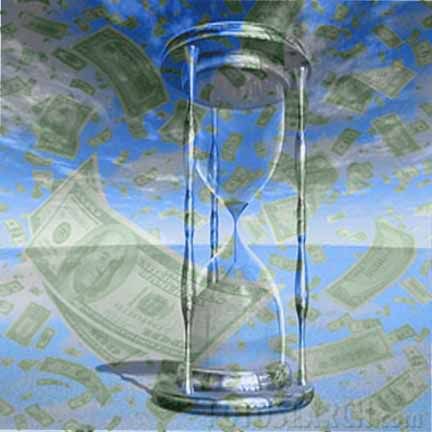
My green year is winding down, and in this last portion of it, I have turned my attention toward the last green-related item I wanted to work with this year: money.
Money has always been a bit of a bugbear for me. When I was a teenager I rejected my comfortable middle-class upbringing and decided I was "anti-materialistic," i.e., anti-money.
I got over that quite some time ago, but the truth is that I've never been good with money. It tends to slip through my fingers alarmingly quickly, and my overall financial life has been very much feast or famine, and utterly chaotic.
So I've been working with a book called The Energy of Money, by Maria Nemeth, which approaches money from a spiritual viewpoint and guides you through a series of exercises to help you become conscious of and heal your relationship with money.
I'm still stuck on Chapter One, in which you are supposed to write your money autobiography. She provides a whole long list of thought-provoking questions to help the process. I shouldn't say I'm stuck, really, because even though I'm moving through this process very slowly, I AM doing it. It's eye-opening to say the least, and so I'm taking the time to really process what I'm writing.
One thing I've realized lately is that as I've been with money, so I've also been with time: confused about where it all goes. Which, of course, brings to mind that saying, Time is money. I never really understood what that meant, primarily because both time and money were such abstract concepts to me that I couldn't really comprehend either of them on a practical level.
But I get it now; it means that money comes to you for time spent earning it. Duh. Conventional wisdom might see this as a one-to-one correspondence: If I work so many hours, I will get so much pay. If I have a "bad" job, the pay will be low and if I have a "good" job the pay will be high. But frankly, I think it sucks either way, and I believe it can be different. In fact, I know it can. There's a sort of momentum that can be created around money that brings a greater and greater return with fewer and fewer hours. I've seen it in people I've written about for my Taos News column, Innovators & Entrepreneurs, and I also just know it intuitively.
Recently I was browsing at one of my favorite websites, mythinglinks.org, and I came across a very interesting page about money. The author of the site, Kathleen Jenks, laments that in terms of earning a living, "it's been unsettling to face the
fact that I've lived most of this lifetime feeling like a racehorse hitched
to a plow."
Reading this really bummed me out, because I can relate. I also recently interviewed a woman for my column whose work life as a freelance writer and a teacher parallels mine. But she just started an online business (her website is journalsandnotepads.com), and she talked about how different this is from freelancing, where you're selling your TIME.
That conversation got me thinking about starting my own online business, but that's a story for another day. The significance for this discussion is that it was yet another pointer to my need to focus on my relationships with time and money. I began to think that perhaps a budget would not be such a bad thing after all. And while I've always been okay with schedules, I haven't been disciplined enough about them when I'm working at home on "my own" time. So I decided that thinking of a schedule as a sort of time-budget might be a better idea - to trick myself into sticking to it, essentially. I've decided that the planner I get for 2012 will have the hours of the day in it so that instead of just making a list of what needs to be done each day, I can actually schedule all of it.
I also signed up at Mint.com. I had read several very good reviews of it, and then came across another one recently that finally convinced me to check it out. And I have to say, I LOVE it. I honestly cannot overstate how much this tool is helping me at last to really grasp my money situation and how to manage it. It's like when you look at what appears to be the chaotic blur of a stereogram and then finally see the image, and go, "Oh wow, yeah," and your eyes relax. For the first time in my life, I have made a balanced budget that is realistically based on what I actually have coming in, and I can see exactly where all of my money is going.
This is both relaxing and and freeing, which is ironic, considering how long I resisted budgeting because I felt it would be so stifling.
It's an interesting side benefit that budgeting my money is helping me budget my time as well. I'm currently writing an ebook for a client who pays me an hourly rate. It's up to me how many hours a week I put in. What I've been able to do is put into my Mint.com budget the amount of money I need to make monthly working on the ebook, and then figure out exactly how many hours a week I need to put in to make that happen. Cake!
All of this has resulted in an incredible feeling of awakening and empowerment in these areas of my life. I realize now that I've always let money and time just kind of happen to me, but I'm increasingly feeling like I'm in the driver's seat. Money and time are tools, and while there will of course be unexpected things that happen and certain limits beyond my power to change, overall it's possible to exercise control over how I receive and use them, and in doing so, the mysterious result is abundance.
Showing posts with label schedules. Show all posts
Monday, November 21, 2011
Saturday, February 6, 2010
The Slow Waxing of Light and Life
This is such an awkward time of year. I'm tired of winter, being housebound, being cold, and I'm still immersed in the inner world of contemplation, to the point that I am fairly grumpy with anyone who wants to distract me from it, which is mainly my children, of course. Rumi said, "My worst habit is I get so tired of winter I become a torture to those I'm with." I relate to that bear in hibernation. Just leave me alone and let me dream. Let me focus on my sap rising, but don't ask me for any of it yet.
Alas, that is not the way it works in Real Life, is it? It's hard to slow down when the world doesn't want you to. And we don't get days off for Tu Bishvat, or for Imbolc and Candlemas, the other two holidays that have occurred recently:
January 29/30 - Tu Bishvat (I discussed this here.)
February 1 - Imbolc.
This ties in nicely for me with Yesod's emphasis on actualizing spiritual concepts. My sap is rising up the Tree, from Malkuth to Yesod, but I needed a jumpstart. These holidays provided me with it. However, the not getting days off really irked me. I ended up spreading my celebrations and rituals out over an entire week, just to fit it all in around my schedule.
My plans were elaborate; I was going to:
I then went through my new exercises for the first time, while listening to The Bee Priestesses, which was remarkably energizing and empowering. After that, I took my ritual bath, which was also a powerful experience, but by then, the day was winding down to the time when the kids come home, so I had to stop there.
Then the boiler that powers my baseboard heater system went out. And I became very aware that elaborate rituals and celebrations are a luxury when you're too cold to function. I was forced to slow down, then. One day I was so cold all I could do was take a bath and get into bed. I slept all afternoon, which was a luxury in itself, and one I haven't indulged in since I can't remember when.
During that period without heat, I thought about homeless people in cold places like New York and Chicago, and I thought about people who don't have any time to themselves because they're too busy surviving, and I felt that strange tension between gratitude and guilt that seems to be a characteristic of citizens of western industrialized cultures.
Am I being frivolous, self-indulgent by doing these things when I "should" be working? This was the question I kept pushing away when I started my celebrations. But after the heater broke, the question was irrelevant, because I was involved in a more basic existence issue. Even being able to ask questions like the one above is a luxury. A privilege, a freedom.
But no. It is not frivolous to do these things if they help me to center and be healthy and grow. It is, however, a luxury, a privilege, a freedom - not to feel guilty about, but to be grateful for. And so, the heater breaking factored into my vows, which hadn't been properly written yet when it happened. I made several vows related to different areas of my life, but the most important one, resulting from my heater ordeal, was to offer gratitude and praise for everything, not in some vague general way, but for specific individual things and people and events as they come into my field of vision, and thus to grow in my awareness of them. Even when they're unpleasant and I don't like them.
So with the burning of the tree*, I let my guilt becomes ashes to feed the earth.
With the blessing and lighting of candles, I awaken my awareness of blessing and light.
With the burying of seeds into earth**, I plant my intentions, and as the seeds die out of their form and grow into something new, I will express my gratitude for the death of my old shell and limits of perspective, and I praise the earth and light and water and struggle that bring forth new life.
Amen.
*The tree burning actually didn't go too well. I had forgotten how long it takes wood to dry. I did manage to singe it a bit, after a half hour involving a lighter, copious amounts of newspaper, very cold hands, and more starter fluid than I care to admit.
**I mixed the body of the dead bee I found at Epiphany into the soil. It just seemed like the thing to do.
Alas, that is not the way it works in Real Life, is it? It's hard to slow down when the world doesn't want you to. And we don't get days off for Tu Bishvat, or for Imbolc and Candlemas, the other two holidays that have occurred recently:
January 29/30 - Tu Bishvat (I discussed this here.)
February 1 - Imbolc.
A day to celebrate the Celtic Brigid, who is goddess or saint, depending on your tradition. In typical Celtic fashion, the goddess and saint stories blend; she was said to be the foster-mother of Jesus. I adore her; she is my divine soul-sister, associated with poetry, the hearth-fire, metalsmithing, midwifery, bees, and sacred wells.February 2 - Candlemas.
A Christian celebration of the return of the light, involving the blessing of beeswax candles, and officially ending the Epiphany season. Traditionally, people would leave up their Christmas greenery until this day.All three of these days celebrate the return of life to the earth, the very beginning of spring's return, the waxing of light. The planting of seeds is a common ritual for all three celebrations. Imbolc and Candlemas are closely associated and the focus is on purification and renewal of vows, rededication to the Path, refocusing, taking new action.
This ties in nicely for me with Yesod's emphasis on actualizing spiritual concepts. My sap is rising up the Tree, from Malkuth to Yesod, but I needed a jumpstart. These holidays provided me with it. However, the not getting days off really irked me. I ended up spreading my celebrations and rituals out over an entire week, just to fit it all in around my schedule.
My plans were elaborate; I was going to:
- burn my Christmas tree which has been standing forlornly in my backyard since Epiphany
- take a meditative orange-tinted salt bath for purification (using kosher sea salt and the Elmo fizzy bath colors Eliana got for Christmas - one yellow and one red)
- begin my Svadhisthana exercises
- bless the orange beeswax candles I bought at Cid's
- then fill the whole house with candlelight, while I
- thoughtfully write out and then recite my spiritual vows for the year
- plant an indoor herb garden with the kit I bought, focusing on the meaning and fruitful fulfillment of my vows (Basil - for love, exorcism, prosperity; Rosemary - for love, purification, and faithfulness; Thyme - for courage, health, and strength)
I then went through my new exercises for the first time, while listening to The Bee Priestesses, which was remarkably energizing and empowering. After that, I took my ritual bath, which was also a powerful experience, but by then, the day was winding down to the time when the kids come home, so I had to stop there.
Then the boiler that powers my baseboard heater system went out. And I became very aware that elaborate rituals and celebrations are a luxury when you're too cold to function. I was forced to slow down, then. One day I was so cold all I could do was take a bath and get into bed. I slept all afternoon, which was a luxury in itself, and one I haven't indulged in since I can't remember when.
During that period without heat, I thought about homeless people in cold places like New York and Chicago, and I thought about people who don't have any time to themselves because they're too busy surviving, and I felt that strange tension between gratitude and guilt that seems to be a characteristic of citizens of western industrialized cultures.
Am I being frivolous, self-indulgent by doing these things when I "should" be working? This was the question I kept pushing away when I started my celebrations. But after the heater broke, the question was irrelevant, because I was involved in a more basic existence issue. Even being able to ask questions like the one above is a luxury. A privilege, a freedom.
But no. It is not frivolous to do these things if they help me to center and be healthy and grow. It is, however, a luxury, a privilege, a freedom - not to feel guilty about, but to be grateful for. And so, the heater breaking factored into my vows, which hadn't been properly written yet when it happened. I made several vows related to different areas of my life, but the most important one, resulting from my heater ordeal, was to offer gratitude and praise for everything, not in some vague general way, but for specific individual things and people and events as they come into my field of vision, and thus to grow in my awareness of them. Even when they're unpleasant and I don't like them.
So with the burning of the tree*, I let my guilt becomes ashes to feed the earth.
With the blessing and lighting of candles, I awaken my awareness of blessing and light.
With the burying of seeds into earth**, I plant my intentions, and as the seeds die out of their form and grow into something new, I will express my gratitude for the death of my old shell and limits of perspective, and I praise the earth and light and water and struggle that bring forth new life.
Amen.
The unexpected completion to my celebrations:
Jenny Stevning posted this drawing as a page to print and color
in response to my mention of her in this post.
Thank you, Jenny. Coloring this was most fun!
*The tree burning actually didn't go too well. I had forgotten how long it takes wood to dry. I did manage to singe it a bit, after a half hour involving a lighter, copious amounts of newspaper, very cold hands, and more starter fluid than I care to admit.
**I mixed the body of the dead bee I found at Epiphany into the soil. It just seemed like the thing to do.
Sunday, September 27, 2009
An Eight-Track Mind
A schedule defends from chaos and whim. It is a net for catching days. It is a scaffolding on which a worker can stand and labor with both hands at sections of time. ~Annie Dillard
It occurred to me recently that I could view my life using the model of a flower, where each of the petals represents a major aspect of my life. Some people have a one-track mind - mine is more like an 8-track, and I need to find a way to divvy up my time and energy and still maintain some sort of balance.
I've always been one to wear a lot of different hats. My entire adult life I've never had a full-time job, but have often had two or three at once, as well as volunteering in various capacities.
For the past few months, I've been working on opening a business, a laundromat called GreenSuds. And this semester, I started teaching college English classes after a year-and-a-half-long hiatus. Now, on top of all that, I started this blog. Adding these new components to my already busy life is what's prompted me to more deliberately prioritize.
So I went online to look for a blank flower diagram that I could fill in, and discovered two things: 1) sites that used to offer that sort of thing for free when I was homeschooling my daughters are now subscription sites, and, 2) apparently the concept of a flower diagram as an organizer is not a new concept.
(I always have mixed feelings when I discover that something I thought I made up already exists. On the one hand, I feel confirmed, validated, and connected to the collective unconscious or whatever, but I can't help but also feel like I've missed a boat. Did you know that I'm actually the person who invented grips on pens and fast food restaurants inside gas stations? I'm the Tesla of trivial ideas.
I really should have known about the flower diagram, since I'm an English teacher and "clustering" is one of the concepts I teach my students for organizing their papers. There's a fine line between a blob surrounded by and connected to other blobs, and a flower with a center and petals.)
Since I couldn't find a blank diagram, I used an actual photo instead, which is much prettier anyway. I have to say, with this blogging business, I've been learning a lot of new skills, but the one that tops the charts this week is learning to put text into a photo.
After I got the basic categories down, I made a two-column list, one column for how strong my desire is to do each activity, and one for how much time that activity requires. I didn't spend a lot of time thinking; I just did it off the top of my head, trusted my initial responses. Looking at it now, I'm not sure how helpful it really is. First of all, it makes me feel guilty, like certain things "should" be higher on the desire list than others. The fact is, all of these things are almost equally important to me, which is why they get to be petals on the flower in the first place. Trying to prioritize them is extremely difficult - at least, doing it this way, by a list.
So I went to Plan B. I wrote out a blank weekly schedule, and then filled it in, and that's what really worked. I realized that I have more time than I thought I did, and more importantly, that it's ENOUGH time to do all of these things, and do them well.
The real problem is when one thing interrupts another's allotted time. For instance, my son keeps interrupting me as I'm writing this. Getting other people in my life (i.e., my children) to respect the aspects of my life that don't involve them is definitely the biggest challenge. Which is another reason why having a fairly orderly schedule is helpful - because then I can say, Right now is my writing time. When I'm done, let's go for a walk.
I'm done. I'm going for a walk.
Subscribe to:
Posts (Atom)

