I've been thinking a lot about the concept of pilgrimage lately. It has been one of those themes that starts coming to me from several different directions at once until I find myself viewing it from a number of interesting angles.
During the writers' conference that I participated in a couple of weeks ago, I had a major epiphany about my relationship with the San Francisco de Asis church. From my very first post about it, I used the word "pilgrimage" to describe what I was doing in walking over there. I said it was like taking a little daily pilgrimage, but what I've now realized is it's not a series of small pilgrimages, but only one, a long and profound one. It's not a long journey in terms of physical distance but of time and moving through layers to an essential core.
And today on Claire's blog, her post is titled "Pilgrimage as Inner Journey," and astoundingly connects with my own experience and thoughts. She starts the post with a pilgrim's prayer, and one of the phrases that really jumped out at me was the plea for "a guide at the crossroads." Because a crossroads is exactly where I am.
Ever since the writers' conference I have been dealing with the sense of moving to a deeper level with my relationship to the St. Francis church and the book I'm writing about it. The piece I submitted for the conference workshop was woven together from various blog posts about the church, and the thematic thread I used was that of nakedness. Some of you may remember my post last fall called "Naked in the Town Square." I drew out the theme from that post to encompass the whole piece, and found it developing in my heart and mind as I did so. Today in Claire's post, she talks about inner pilgrimage as a process in which she hands over to God all her life, both inner and outer, a process which feels like "stripping bare."
I am naked at the crossroads right now, because the conference made me realize that this book I'm writing is no longer hypothetical - I'm really doing it, and that process means getting more deeply involved with the church. It occurred to me that it's time to talk to the priests and let them know what I'm doing, that it's only respectful to do so. And also that one of my desires is to weave journalistic writing in with my memoir-ish stuff, and in order to do that I must connect with actual members of the church, get to know them, interview them. It's time to move beyond the courtyard and enter the building, the body. And this frightens me, for a number of reasons: Fear of approaching people I don't know, doubt of myself having the "right" to be writing this book, boldness to claim that I'm doing so, putting myself and my writing out there to be scrutinized by people who have been members of the church all their lives. Naked, naked, naked, in the stark light of day. It would be so much easier to keep sitting in the courtyard with the hummingbird moths.
But honestly, the thing that frightens me most is in how I will be altered by deepening my relationship with this church. I fear that I will be swept away, lose myself to it. I have been flirting with the church, and now I'm confronted with the choice to make a commitment that I have no idea where it will lead.
Claire speaks of pilgrimage as a time of testing and says, "There is always a moment when it gets too much." And to continue beyond this point requires surrender. This is the crossroads where I now find myself. Will I, as Claire puts it, allow the path I'm walking to "walk me?" Even as I write this though, I realize it already is, even though I still have strong resistance.
Just now the church bells began ringing, calling the people to worship. Today is the feast day of Santiago, and the annual Taos fiestas honoring this saint are in full swing downtown. Hearing the bells, I feel an aching longing to be at the mass, but fear holds me back. I'm not Catholic and I don't know how to do things like enter the pew and even if I did I would feel like a fake going through those movements. I don't know the words spoken and sung during mass that Catholics know by heart, many of which are in Spanish, which I don't speak. I don't know if they have childcare for Eliana or if I'm supposed to keep her with me, and I'm too afraid to ask. And so I don't go. I sit here and write about it instead.
Interestingly, the specific pilgrimage Claire refers to is the Camino de Santiago in Spain, and she writes of currently being elsewhere in the world, missing that place, knowing that today there is a huge celebration of the saint for which it's named.
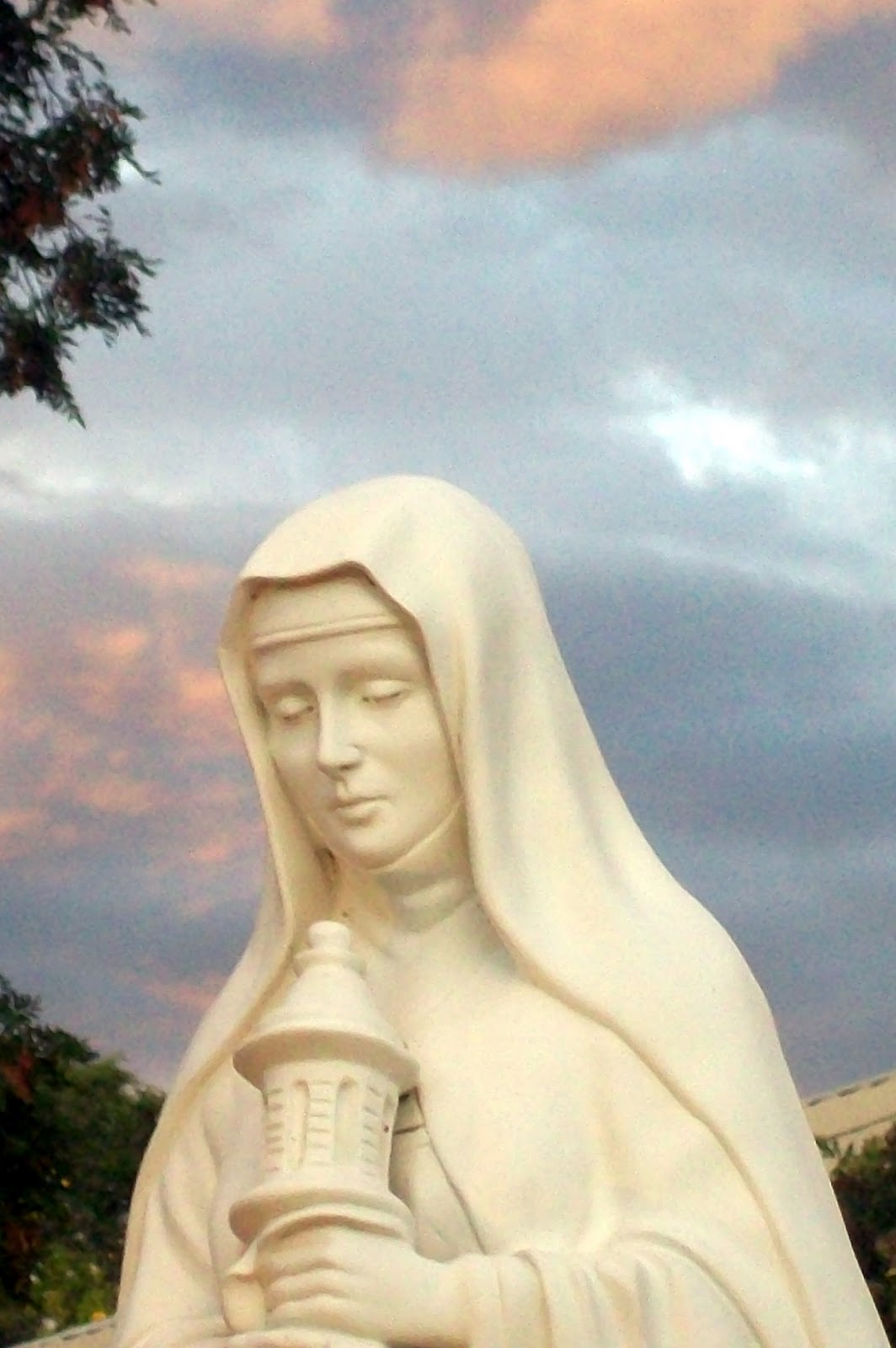
An amazing thing that came to me through the conference was in a discussion I had with one of the other participants who said she sensed that my deepest connecting point with the church is through St. Clare, not only in terms of the statue in the courtyard that I love, but also her story, that this woman perceived wants to be told and lived through me. So today I am thankful to both my Cla(i)res for being my guides at the crossroads, and the awesomeness of this interlacing is not lost on me.
The name, Cla(i)re, of course, is related to clarity and light. I have many photos of the statue of Clare in which she is framed by incredible clouds. This is the metaphor I turn to today. Recently I closely inspected an iron cross in the courtyard that I had never paid much attention to before. I discovered that there is a Latin inscription on it, "Occurrent nubes," which Googling led me to learn means, "Clouds will intervene." I love the mystery of this, I love that I can look at the clouds of my own doubt and fear and see how they interfere with my clear direction, but also in some way contribute to the overall pilgrimage. A pilgrimage is not a straight walk from here to there. Clouds refract light into variegated beauty. They soften the harsh light that exposes nakedness. They intervene on behalf of clarity if I only pay attention and keep walking the path, however haltingly.
Showing posts with label Catholicism. Show all posts
Sunday, July 25, 2010
Saturday, January 23, 2010
The Body, the Shekhinah, and Father Bill: A 2009 Retrospective
This time last year I was incredibly isolated and just beginning to fully recognize the effects of my black sludge moods on those I love. I had lived in Taos for only a few months, was working at Subway (!) and struggling to survive, was getting my arse kicked by winter, and generally not having a good time of it.
But then I decided to get proactive about my life. I visited with a couple of alternative health practitioners and got some recommendations about how to change my diet and my attitude. I began to embrace my physical being in a way I never had before. I read voraciously anything related to eating, from the health-oriented to the political. Animal, Vegetable, Miracle by Barbara Kingsolver. Harvest For Hope by Jane Goodall. The Art of the Inner Meal: Eating As A Spiritual Path by Don Altman. Eat Right 4 Your Type by Peter D'Adamo. Information about pH balance in the body, about veganism, about Ayurveda, about fasting and cleansing, about the global food crisis, the importance of eating locally produced food.
As I researched and experimented with different ways of eating, I finally found the way that's right for me, and it changed my life profoundly. I learned to listen to my body more deeply and to trust its knowing. I began to see life as a body adventure, and was amazed to realize how much simply changing my diet changed the way I felt emotionally and spiritually. It was humbling to realize that all my so-called spiritual methods of dealing with my mood/anger problem paled in its effects compared to just eating differently.
At the same time, I became acquainted with the Shekinah, and true to my peculiar path, she started popping up simply everywhere. The Shekinah, representative of the immanence of the divine in the physical world, was an absolutely fitting guide as I went about learning to live in harmony with my body. My big epiphany was that mind and body are one - not in the sense of two things united, but of ONE thing manifested as different aspects. Just as the Shekhinah is an aspect of the divine and not a separate thing or person.
This exploration led me deeper into mystical Judaism, something I had already been dabbling in for years. In the Kabbalistic Tree of Life, the Shekhinah is associated with the tenth sephirah, Malkuth, or Kingdom. "She" is the manifestation of Spirit in the physical world. Suddenly, in the middle of a bleak January, I found myself deeply inspired and energized.
One of the first things that led me into this exploration was a showing of the art of Father William Hart McNichols, an iconographer. The first or second week I lived in Taos, there was an article about him in the Taos News because his show was about to open. He's a Catholic priest who is known worldwide for the icons he paints. The odd thing about this is that the iconography tradition is Orthodox, not Catholic. The other odd thing is that many of his icons are not of traditionally recognized saints. One is of a Buddhist woman, one is of the poet Gerard Manley Hopkins, another is of an Islamic mystic. There's even one of Princess Diana. If you click on the above links, you can also read his commentary about each icon.
Father Bill, as he is called, is a wonderful, wise, poetic man. And openly gay. In fact, there is an article in Time magazine in which he discusses this. He's celibate, as a priest vows to be, but admits that his orientation is homosexual.
I rarely visit art shows, but I was determined to see his, and I'm glad I did.
Standing before the original icons was so much more powerful than looking at reproductions of them, particularly because of the real gold mixed in with the paint used for the halos. There was a sheet provided with background information on each of them. One of the icons was called, "The Name of God, Shekhinah" and was simply the Hebrew letters that spell that name. But his commentary on it was what I was really taken with and what set me off on the Shekhinah pilgrimage. He talked about seeing the Shekhinah in the mist that often rests on Taos Mountain, and in the glow of a candle. He talked about the Shekhinah being the feminine Spirit of God. In Jewish theology, she is the Bride of God, the Sabbath Bride, and women light candles on the Sabbath eve to welcome her in.
I was and am utterly smitten with Father Bill. (Leave it to me to develop a crush on a gay priest.) I felt a connection to him right from that first article I read, but then kind of forgot about him. Then, one morning during Advent, I just happened to turn on the radio, which I rarely do when I'm home, and he was talking to Nancy Stapp, a wonderful local radio personality. He was discussing the meaning of Advent, and while I no longer remember exactly what he said, I remember being absolutely calmed and inspired by it, and consistently nodding and saying Yes, exactly, to the radio. And I remember he ended with an ancient Persian prayer to the sun.
A few months later during Lent, I had the same uncanny experience of turning on the radio, and lo, there he was talking to Nancy again, this time about the meaning of Lent. And he talked about the Shekinah.
Then, in June, I moved into the neighborhood of the St. Francis church and discovered that he is the assistant Priest for that parish.
Other than Christmas Midnight Mass, I've only been to mass there once, and he just happened to be preaching that day. And what he preached about was Sophia, the feminine personification of wisdom, often associated with the Shekhinah. He also talked about the tendency of religious people to be judgmental and stingy with their acceptance and forgiveness of others, to segregate and create an us versus them mentality. He told the congregation to go home and look up the word "catholic." Which, of course, I eagerly did. Here's what I found:
But in the meantime, I'm curious - where were you a year ago? How has your life changed over the past year?
But then I decided to get proactive about my life. I visited with a couple of alternative health practitioners and got some recommendations about how to change my diet and my attitude. I began to embrace my physical being in a way I never had before. I read voraciously anything related to eating, from the health-oriented to the political. Animal, Vegetable, Miracle by Barbara Kingsolver. Harvest For Hope by Jane Goodall. The Art of the Inner Meal: Eating As A Spiritual Path by Don Altman. Eat Right 4 Your Type by Peter D'Adamo. Information about pH balance in the body, about veganism, about Ayurveda, about fasting and cleansing, about the global food crisis, the importance of eating locally produced food.
As I researched and experimented with different ways of eating, I finally found the way that's right for me, and it changed my life profoundly. I learned to listen to my body more deeply and to trust its knowing. I began to see life as a body adventure, and was amazed to realize how much simply changing my diet changed the way I felt emotionally and spiritually. It was humbling to realize that all my so-called spiritual methods of dealing with my mood/anger problem paled in its effects compared to just eating differently.
At the same time, I became acquainted with the Shekinah, and true to my peculiar path, she started popping up simply everywhere. The Shekinah, representative of the immanence of the divine in the physical world, was an absolutely fitting guide as I went about learning to live in harmony with my body. My big epiphany was that mind and body are one - not in the sense of two things united, but of ONE thing manifested as different aspects. Just as the Shekhinah is an aspect of the divine and not a separate thing or person.
This exploration led me deeper into mystical Judaism, something I had already been dabbling in for years. In the Kabbalistic Tree of Life, the Shekhinah is associated with the tenth sephirah, Malkuth, or Kingdom. "She" is the manifestation of Spirit in the physical world. Suddenly, in the middle of a bleak January, I found myself deeply inspired and energized.
The Kabbalistic Tree of Life
One of the first things that led me into this exploration was a showing of the art of Father William Hart McNichols, an iconographer. The first or second week I lived in Taos, there was an article about him in the Taos News because his show was about to open. He's a Catholic priest who is known worldwide for the icons he paints. The odd thing about this is that the iconography tradition is Orthodox, not Catholic. The other odd thing is that many of his icons are not of traditionally recognized saints. One is of a Buddhist woman, one is of the poet Gerard Manley Hopkins, another is of an Islamic mystic. There's even one of Princess Diana. If you click on the above links, you can also read his commentary about each icon.
My magic mirror.
The two icons on the left side are by Father Bill
I rarely visit art shows, but I was determined to see his, and I'm glad I did.
The poster announcing Father Bill's show.
I snagged it from a coffee shop (with the owner's permission.)
Standing before the original icons was so much more powerful than looking at reproductions of them, particularly because of the real gold mixed in with the paint used for the halos. There was a sheet provided with background information on each of them. One of the icons was called, "The Name of God, Shekhinah" and was simply the Hebrew letters that spell that name. But his commentary on it was what I was really taken with and what set me off on the Shekhinah pilgrimage. He talked about seeing the Shekhinah in the mist that often rests on Taos Mountain, and in the glow of a candle. He talked about the Shekhinah being the feminine Spirit of God. In Jewish theology, she is the Bride of God, the Sabbath Bride, and women light candles on the Sabbath eve to welcome her in.
I was and am utterly smitten with Father Bill. (Leave it to me to develop a crush on a gay priest.) I felt a connection to him right from that first article I read, but then kind of forgot about him. Then, one morning during Advent, I just happened to turn on the radio, which I rarely do when I'm home, and he was talking to Nancy Stapp, a wonderful local radio personality. He was discussing the meaning of Advent, and while I no longer remember exactly what he said, I remember being absolutely calmed and inspired by it, and consistently nodding and saying Yes, exactly, to the radio. And I remember he ended with an ancient Persian prayer to the sun.
A few months later during Lent, I had the same uncanny experience of turning on the radio, and lo, there he was talking to Nancy again, this time about the meaning of Lent. And he talked about the Shekinah.
Then, in June, I moved into the neighborhood of the St. Francis church and discovered that he is the assistant Priest for that parish.
Other than Christmas Midnight Mass, I've only been to mass there once, and he just happened to be preaching that day. And what he preached about was Sophia, the feminine personification of wisdom, often associated with the Shekhinah. He also talked about the tendency of religious people to be judgmental and stingy with their acceptance and forgiveness of others, to segregate and create an us versus them mentality. He told the congregation to go home and look up the word "catholic." Which, of course, I eagerly did. Here's what I found:
1. broad or wide-ranging in tastes, interests, or the like; having sympathies with all; broad-minded, liberalFather Bill is a shining example of this kind of catholicity. And while we've never met, he was a profound influence on my growth over the past year, a journey which continues to bloom in unexpected and strangely harmonic ways, as you'll see in my next post.
2. universal in extent; involving all; of interest to all.
3. pertaining to the whole Christian body or church.
But in the meantime, I'm curious - where were you a year ago? How has your life changed over the past year?
Wednesday, October 21, 2009
The Dance of Teonantli
**This is a repost - Somehow I managed to delete it from my published posts when I was trying to view it.**
I've been doing some reading about the San Francisco de Asis church. It's surprising to me how little literature is available, but I checked out the two books that they had at the library, one of which features many different artists' paintings and photos of the church, and the other of which focuses on the restoration that occurred in 1979.
I've discovered a few interesting things. First, there's some controversy about when the church was actually built. It could have been as early as 1710 or as late as 1810 - a hundred year discrepancy that even the church records don't clarify. Neither book acknowledges the statues of Clare and Francis that I so adore. I went into the church gift shop and the woman at the counter said the Francis statue has been there maybe ten years, and the one of Clare only for four or five. She didn't know who made them. An online search for this information brought me to my own blog.
In the book about the church restoration, titled simply Ranchos de Taos, I learned that the annual remudding of the church was traditionally done by the women. In recent decades, it seems this has changed. I'm not sure they even make it an annual event anymore, but for a long time, it was a ritual as sacred as any that took place inside the building.
As I mentioned in another post, I'm inspired by the fact that the energy of many hands is infused into the walls of the building, giving it a quality of aliveness. That most of those hands have been women's is very interesting to me. It just makes sense. The shape of the building, with its rounded edges, and the velvet look and feel of the adobe both suggest femininity, a softness embodying strength. Catholics refer to "Mother Church," and in the case of the Ranchos church, this is especially fitting.
The feminine aspect of the Ranchos church has also come to me in another way recently. When I went to the bazaar held at the church school, I was completely enchanted by the performance of a dance group made up of five women and a teenage boy (the son of one of the dancers). Once I can figure out how to do it, I'll update this post with the video that I took of them dancing.
One of the women introduced the group as Teonantli, which means "our godly mother" in Nahuatl, the language of the Aztecs. She said that with this name, they "give honor to Mary, The Mother of God; Our Mother Earth; and to all mothers." She said that each danza is a prayer, which is why they begin by forming a cross with their feet. They also form a cross in the offering of sage and copal, with smoke rising out of a ceremonial cup.
The danzas were riveting. As one of the dancers told me later, their purpose is to create "powerful, kinetic, spiritual prayer." They were accompanied by flute, a large standup drum called a huehue, and a small hand drum (teponatzli). While three men drummed, the dancers performed intricate, harmonized movements, enhanced by the use of a variety of items.
They began their danzas by blowing through conch shells (caracols), which reminded me of the Jewish tradition of the shofar.
They do this to honor the four winds or compass directions, and also to ask permission of the Animas (souls of ancestors) to open the circle. They do it again at the end to give thanks and ask permission to close the circle.
The headdresses that you see are called copilli, and the ankle bracelets (ayayotes) are actually rattles. Each of the costumes is uniquely decorated with elaborate designs and images in the Aztec style.
I apologize for the fuzzy quality of the photo below left, but I really wanted to show this costume detail. The woman on the right is holding a sonaja, a hand rattle.
During the danzas, the buildup of kinetic and spiritual "charge" was tangible, and the dancers sometimes spontaneously shouted, "El es Dios," meaning "He is God."
These are ordinary women. One works for a judicial district office, another for the Department of Public Health. As you can see in the photos, this performance took place in a cracked parking lot surrounded by orange construction barrels. And yet, through their inspiration, devotion, and intention, the dancers created an electric, mesmerizing experience, fascinating in its blend of Aztec and Catholic elements. As one of the dancers put it:
For centuries the Aztecs honored many gods: the god of rain, fire, wind, war, healing, and many others. The danza has incorporated into it many aspects of the Catholic faith brought to the new world by the Spaniards. Each step (paso) is a prayer.It was primarily the Franciscans that brought the Catholic faith to Mexico. Ironically, this order, of the lineage of the gentle and respectful St. Francis, forced Catholicism on the Aztecs, sometimes violently. What resulted has been seen in many cultures, a hybridization of religious belief and practice. One of the primary manifestations of this was the incorporation of the Virgen de Guadalupe into the Catholic faith of the Mexicas. The Aztecs could not accept a religion that did not venerate both a male and a female deity. But the Franciscans could not accept a non-monotheistic religion. Interestingly, in pre-Christian Aztec religion, women played important priestly roles, and in at least one festival, women priests led dancing rituals.
The world has historically operated from such an us-against-them position. But ever so slowly, it seems to be changing. Many people are examining their collective pasts, synthesizing traditionally disparate elements. Where there was once a battle, there is now a dance. Teonantli is a glorious example of this. This group - in blending Aztec and Catholic, dance and prayer, reverence for the Father and the Mother - creates a seamless collage, a beautiful enigma, and ultimately, redemption and healing.
Subscribe to:
Posts (Atom)


